|
How could this be? The first movie nude scene occurred 10 years before movies were "invented." If you are an old fart like me, you realize how time has a way of singling out bits and pieces of history in the process of compiling the popular version, leaving other fragments, sometimes the most important ones, on history's equivalent of the cutting room floor. Many factors contribute to this. Some people's roles in history are minimized because of political incorrectness (Werner von Braun, e.g.), others are elevated or reduced because of their own national origin and the national origin of the storyteller, still others are promoted or demoted by the official version sponsored by corporate America. The
history of motion pictures is no exception to the
rule. Various historical icons like Thomas Edison
and the Lumiere brothers have been promoted to
inventor status for various reasons. The British,
rejecting the French and American choices, have
their own champion, a man named William
Friese-Greene, who "was the first man ever to
witness moving pictures on a screen," according to
some sources. He was not. He was not even close.
Friese-Greene beat Edison and the Lumieres, but was
about a decade behind the real champion. Long before these candidates, there was actually a crazy British expatriate who proved to be too politically incorrect for the history books. He not only beat the famous "inventors," but invented movie nude scenes as well. In fact, he was actually filming naked women in motion more than a decade before Edison or the Lumieres had ever successfully completed their own systems. Let's begin with a definition. What is a movie? For the sake of our analysis here, it is "projected motion photography." This definition eliminates the peep show, which was clearly a predecessor to movies, but not an actual movie. On May 4, 1880, Muybridge projected animal motion scenes for several objective spectators in San Francisco. Everyone in that room saw projected moving pictures nine years before Friese-Greene became "the first man ever to witness" them! Although no mention of Muybridge's demonstration - really the first movie - is included in some current published chronologies of the medium, the event was reported in great detail at the time. Three San Francisco newspapers reported the event the next day, and a California weekly reported it in their May 8 edition. The San Francisco Alta reviewed the exhibition in great detail, and wrote: "Mr. Muybridge has laid the foundation of a new method of entertaining the people, and we predict that his instantaneous photographic magic-lantern zoetrope will make the rounds of the civilized world." That turned out to be the first, and possibly still the most accurate, movie review ever written. |
|
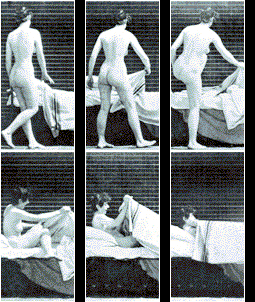 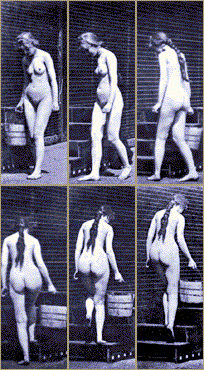   |
By 1884, Muybridge was engaged in scientific research of motion photography at the University of Pennsylvania. His notebooks have been preserved in great detail at the George Eastman House in Rochester, N.Y. Here are some entries from 1885:
I'm not sure which one was filmed first, but to the left are four of his compositions from the 1884-1886 period. One of those may be the first nude scene ever filmed. The tri-colored one is probably the first example of a single scene filmed from multiple angles with several cameras. |
|
That was in 1885, mind you. Muybridge was filming nude scenes 10 years before the Lumieres were filming anything! The Lumieres held their first public exhibition in December of 1895, and they can probably be credited with the first known instance of a filmed fictional story. The previous efforts had been scientific documentations of motion, often in controlled studios with pure black or white backgrounds marked by height grids, like a police line-up. The Lumieres exhibited something called "Watering the Gardener," which was a little staged comedy. As for Edison, he didn't even master peep shows until a decade after Muybridge had demonstrated projection! Lacking any projection technique of their own, Edison's corporate people convinced Thomas Armat, a Washingtonian who had successfully developed a projector, to allow the Edison Company to market his product as Edison's own work. They argued quite persuasively that their marketing muscle and Edison's reputation would ensure commercial success for the product and make everyone more money in the long run. Armat agreed to the deal, and an Edison employee named W.K.L Dickson adapted Armat's Phantoscope projector, renaming it The Edison Vitascope. Hailed as the latest miracle from the Wizard of Menlo Park, the Vitascope's highly publicized debut occurred at Koster & Bials Music Hall in New York on April 23, 1896. It was promoted as a revolutionary exhibition, despite the fact that Muybridge had devoted an entire hall to film projection at the Chicago World's Fair in 1893!! What happened to Muybridge's place in
history? A lot. the French didn't want an insane
Englishman to have invented movies. The Americans
wanted their man. The Edison Company wanted their
own version to become the official history, because
that was most profitable version for them. The
British rejected a tainted expatriate in favor of a
safer, more English candidate, albeit one with an
inferior claim. Nobody wanted to give the
credit to a confessed murderer who collected
images of naked prostitutes. Everybody
just wanted Muybridge to go away. And so he did, at
least until quite recently, when his accomplishments
were rediscovered and re-evaluated. "Insane?" you think, "Murderer? Isn't that melodramatic?" He
admitted to the latter, and his own lawyers claimed
the former. Several years before his 1880 exhibition,
Muybridge stalked and killed his wife's lover at
point blank range with dozens of witnesses. He was
jailed for three months before his trial for first
degree murder. He acknowledged premeditation during
his testimony. His lawyers used a two-edged defense:
(1) they used the legal argument that he was not
guilty by reason of insanity; (2) they snuck in the
utterly extra-legal sympathy argument that killing
one's wife's lover was a justifiable act. The jury
rejected the insanity argument, but Muybridge was
acquitted anyway - despite having no legitimate
legal defense after the insanity argument fell
apart. He owed his freedom to the unpredictability
of the American jury system in the 19th century
West. ================= One man who beat even Muybridge was Henry Renno Heyl, a Philadelphia inventor whose Phasmatrope was demonstrated on February 5, 1870, at Philadelphia's Academy of Music. Some 1,500 spectators watched a program that included a couple waltzing, an acrobat performing, and a character called Brother Jonathan delivering a speech. The dancing was even synchronized with a live orchestra. Heyl's invention used photographs printed onto glass transparencies, mounted on a rotating mechanism and projected by a magic lantern. It was primitive, but it worked. And a second demonstration took place at the Franklin Institute on March 16, 1870. There is, however, an important distinction between what Heyl and Muybridge accomplished. Heyl's subjects had to pose for a series of separate photographs. Muybridge, by contrast, had developed a way of photographing successive phases of actual movement, beginning with his famous experiments involving galloping horses in 1878. If we accept drawn images as motion pictures, an even earlier claimant emerges: Leopold Ludwig Döbler. On January 16, 1847, this Austrian magician presented moving images to an audience at Vienna's Josephstadt Theatre using his Phantaskop. His program included an animated woodcutter, a tightrope walker, a dancer and two duellists. These were sequential paintings, not photographs, but they were projected moving pictures. |
|
